
About Us
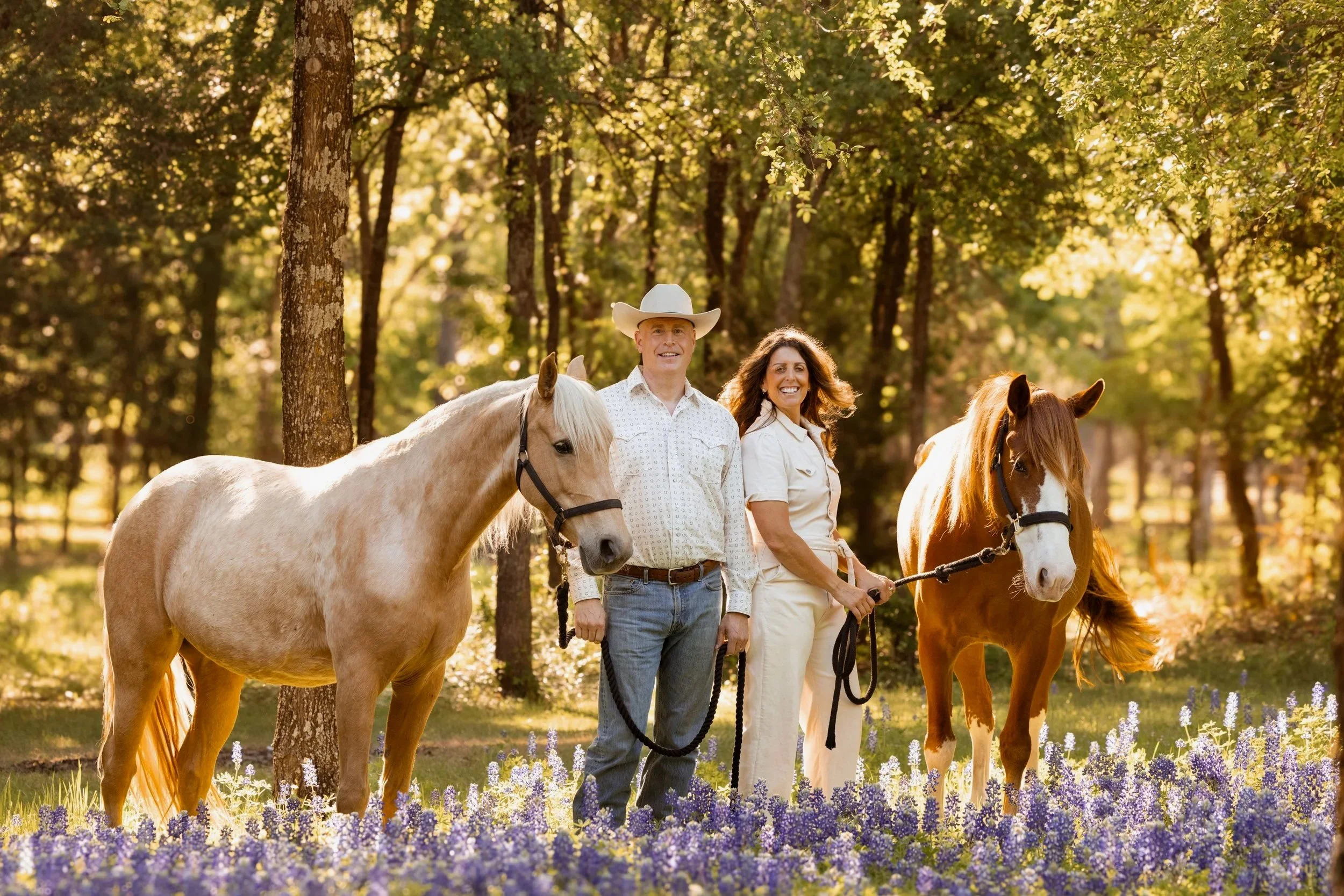
Meet Sarah and James
James is a decorated, retired Baltimore City Police Commander, now finding his calling supporting large scale research initiatives at the UT Health Houston, school of public health discovered his love of riding during Covid. He jumped in with both feet because horses demand presence, honesty and patience in a way that nothing else does.
Sarah is the epitome of “Boardroom to Barnyard,” with several decades of executive leadership in Lifesciences, Sarah happily spends her time with equines, finding joy, grounding and connection in the barnyard as much as she once did in the board room. This allows her to truly get back to her roots as she took her first ride at 18 months old and has been a true animal lover ever since. Growing up, she spent many Summers with her Gram and Grandfather, on their family farm, developing a lifelong connection to animals and the land.
In her late, 30s she experienced a gnarly horse trail accident, leaving her to swear off horses, until one heart horse, Solomon… brought her back in! That connection ultimately led her onto the largest Mountain Pleasure Horse Farm, the Rockin’ R and the rest is history!
Both Sarah and James have found solace, healing and grounding in the company of their equines and they are truly blessed to be able to share these amazing horses and continue to be conservation stewards of this breed.

Mountain Pleasure Horses are almost quietly perfect for Equine-Assisted Learning (EAL)—not because they were designed for it, but because everything about their history and makeup naturally aligns with what those programs need. In EAL, the horse isn’t just part of the environment—it’s part of the feedback system. You want a horse that responds clearly, stays emotionally regulated and doesn’t overwhelm the participant. Mountain Pleasure Horses hit that sweet spot. They offer honest, readable feedback without adding unnecessary stress to the situation. Our 501.c.(3) aims to champion Mountain Pleasure Horses within EAL programs.
Naturally Calm, People-Oriented Temperament
These horses were bred to live closely with families in the Appalachian Mountains—not just as tools, but as daily companions. Over generations, that selected for horses that are:
Gentle and non-reactive
Patient with inconsistent handling
Highly attuned to human emotion and body language
In equine-assisted learning, where participants may be anxious, inexperienced, or processing emotions, this kind of steady temperament is invaluable. Mountain Pleasure Horses tend to meet people where they are, without escalating tension. Mountain Pleasure Horses reflect a participant’s energy (which is a core principle of EAL), but they’re unlikely to overreact or “blow up” in the process. This creates a safe learning loop—participants can see the impact of their behavior without feeling overwhelmed. Low Reactivity + Emotional Sensitivity
Smooth, Predictable Movement
Their signature natural four-beat gait (the saddle rack) is incredibly smooth and consistent.
For mounted programs, this matters more than people often realize:
Reduces physical tension in the rider
Helps participants relax more quickly
Builds confidence, especially for beginners or those with sensory sensitivities
Instead of bracing against movement, riders can focus on connection, awareness, and communication—which is the real goal of EAL.
Steady, Uncomplicated Nature
Because they were bred for practical, everyday use—not high-strung performance—they tend to be:
Straightforward to handle
Forgiving of mistakes
Consistent from day to day
In a learning environment where participants are trying new things (often awkwardly), this reliability creates psychological safety. The horse isn’t going to “punish” uncertainty—it just responds clearly and fairly.
Size and Approachability
Most Mountain Pleasure Horses are:
Medium-sized
Well-proportioned
Non-intimidating in presence
For participants who may already feel vulnerable, a horse that feels physically approachable can make a huge difference in willingness to engage.
Rooted in Partnership, Not Performance
This might be the most underrated factor. These horses were never bred to “win” in the modern sense—they were bred to:
Work alongside humans
Adapt to human needs
Be dependable partners
That legacy shows up in how they interact today. They tend to prioritize connection over dominance or avoidance, which aligns beautifully with the goals of equine-assisted learning.
Mission: Maintain and expand continuous conservation of Mountain Pleasure Horse breed through education and Equine Assisted Learning programs.